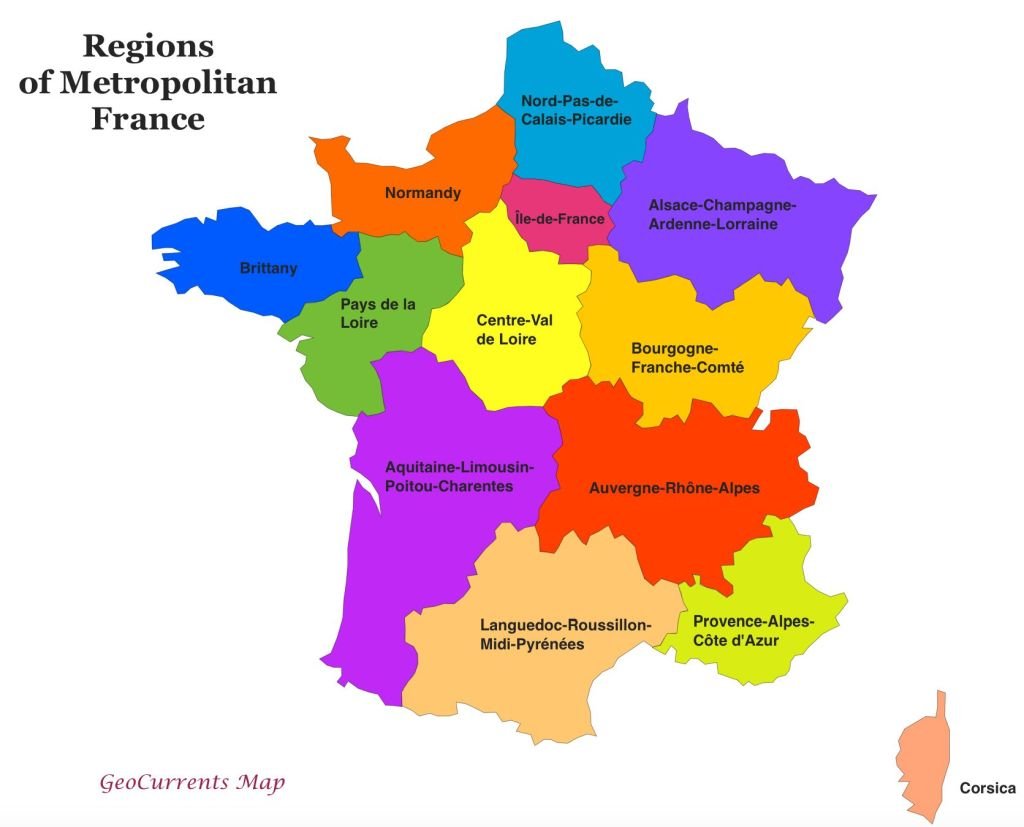
France is divided into 18 administrative regions: 13 metropolitan regions in Europe and 5 overseas regions. These regions, reformed in 2016, serve as primary subnational administrative divisions for economic planning and local governance. Major regions include Île-de-France (Paris), Provence-Alpes-Côte d’Azur, and Nouvelle-Aquitaine.
Metropolitan Regions (13)
Auvergne-Rhône-Alpes: Lyon (Includes Alps and Massif Central)
Bourgogne-Franche-Comté: Dijon/Besançon (Vineyards)
Bretagne (Brittany): Rennes (Coastal, Celtic culture)
Centre-Val de Loire: Orléans (Loire Valley castles)
Corse (Corsica): Ajaccio (Island in Mediterranean)
Grand Est: Strasbourg (Alsace, Champagne, Lorraine)
Hauts-de-France: Lille (Northern, mining history)
Île-de-France: Paris (Capital region)
Normandie (Normandy): Rouen/Caen (D-Day beaches)
Nouvelle-Aquitaine: Bordeaux (Southwest, Atlantic coast)
Occitanie: Toulouse/Montpellier (Pyrenees, Mediterranean)
Pays de la Loire: Nantes (Western Loire)
Provence-Alpes-Côte d’Azur (PACA): Marseille (French Riviera)
Overseas Regions (5)
These regions have the same status as metropolitan regions:
european-union.europa.eu
Guadeloupe: Caribbean
Guyane (French Guiana): South America
Martinique: Caribbean
Mayotte: Indian Ocean
Réunion: Indian Ocean
Historical/Former Regions
Before the 2016 reorganization, there were 22 regions. Notable changes included merging Basse-Normandie and Haute-Normandie into Normandy, and combining regions like Languedoc-Roussillon with Midi-Pyrénées to form Occitanie.
Leave a Reply